A model that even a powerful laptop cannot load into memory can be trained in just a few hours by distributing the workload across thousands of parallel cores. The real limitation lies not in the complexity of the algorithm, but in the physical hardware that supports it. This boundary now defines any serious artificial intelligence project because, without sufficient computing power, even the most elegant and well-designed architecture remains idle, unable to move forward. Below, we explore why AI models place such heavy demands on hardware, how remote graphics cards overcome these limitations, and what benefits cloud computing offers.
Why today's AI models are so demanding on hardware
Recent language and vision models handle billions of parameters. Each step of the training process involves multiplying enormous matrices repeatedly, a repetitive and computationally expensive operation that a conventional CPU, lacking massive parallelism, performs sequentially, processing data one operation after another and therefore at a considerably slower pace. Graphics cards, by contrast, were designed to perform thousands of operations simultaneously, making them the natural engine for these processes.
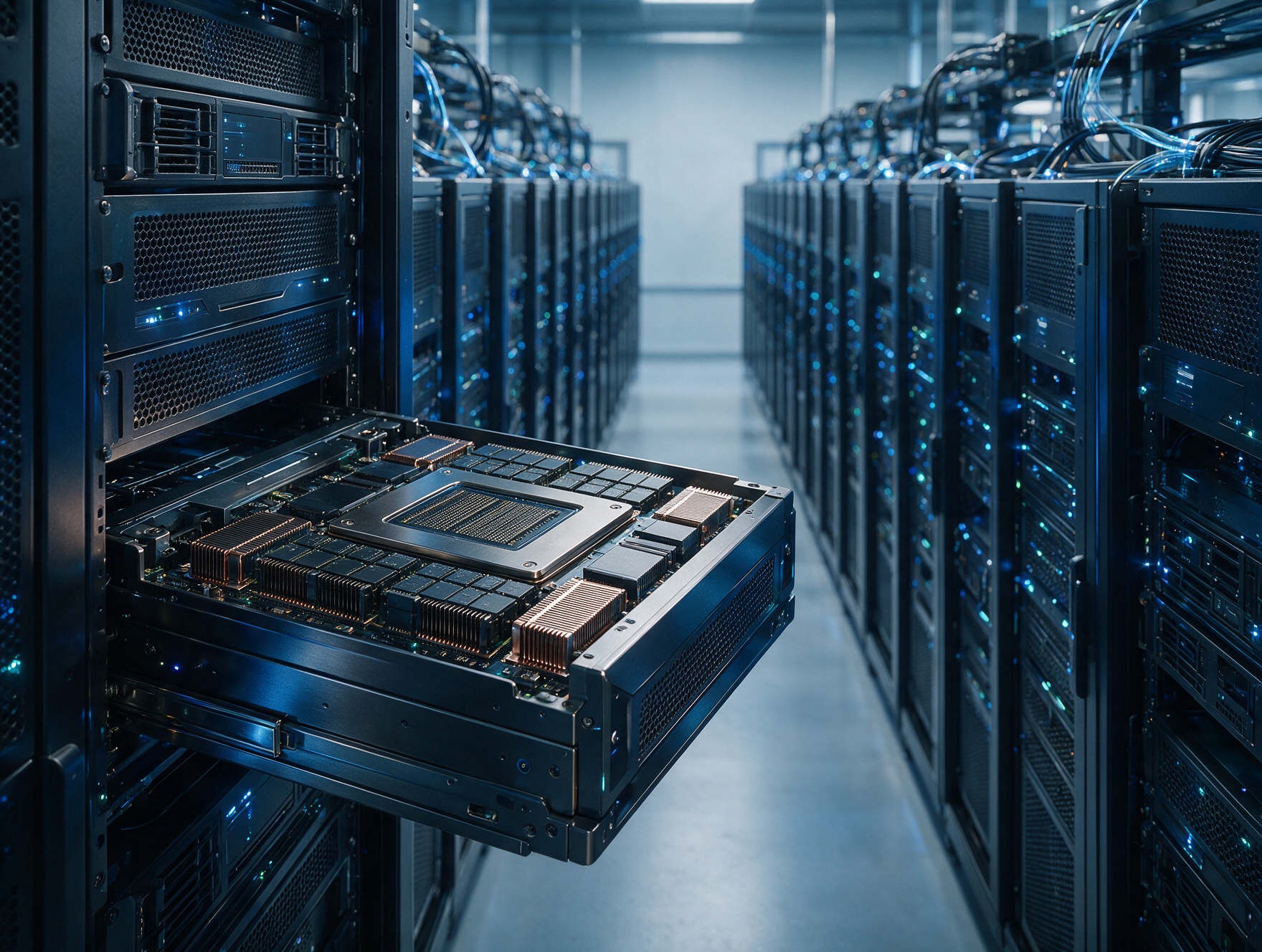
To train and run large AI models, a cloud GPU instance provides direct access to the parallel computing power these processes require without relying on dedicated physical hardware. This is a crucial point: the video memory needed to accommodate a large model can easily exceed that of any consumer-grade computer, while the energy consumption of an in-house cluster can be difficult for a small team to afford. Remote access to this computational power removes the barrier to entry that previously excluded many projects.
How GPU clouds work compared to conventional data centers
A traditional data center operates with an estimated fixed workload. When a project grows, more machines must be purchased; when demand decreases, equipment remains unused. A cloud-based GPU architecture works differently, pooling physical resources and distributing them among different users on demand through virtualization.
This structural difference translates into several practical advantages for those who regularly develop artificial intelligence solutions:
- There is no upfront investment in hardware that quickly becomes outdated.
- The provider handles maintenance, cooling, and upgrades.
- Multiple connected graphics cards make it possible to distribute a single training workload.
- Computing capacity can be adjusted in minutes rather than weeks.
Anyone interested in understanding the different types and benefits of cloud computing will find a broader explanation of the flexible resource allocation model on which this approach is based. Virtualization is ultimately what makes it possible to treat computing power as a service rather than as an asset that must be maintained in a dedicated facility.
Practical acceleration: how GPU virtual machines reduce inference times
Why can the same query sent to a model take several seconds when processed by a CPU, while requiring only milliseconds when handled by a graphics card? The answer lies in parallelism, which makes it possible to perform many operations simultaneously. Inference, the specific moment when an already trained model responds to a user's request, also breaks down into numerous matrix operations, just as training does, which a graphics card can process simultaneously.
For an application running in production, this makes the difference between a smooth user experience and a frustrating one. An assistant that responds instantly, a recommendation system that processes thousands of requests per second, or an image recognition service all depend on low latency. It is worth remembering that raw computing power requires reliable physical infrastructure: in on-premises installations, even details such as suitable power cables influence overall system stability. By moving inference to specialized virtual machines, responsibility for electrical and thermal infrastructure shifts away from the developer, who can focus entirely on application performance.
Flexibility and scalability: adapting computing power to each AI project
If acceleration answers the question of "how much faster," flexibility addresses the more nuanced issue of "how much computing power do we need, and exactly when do we need it?" A project rarely consumes the same resources at every stage: initial training requires enormous computing capacity for days, while testing or operating the deployed service generally requires much less. Paying for fixed capacity designed to handle peak demand would represent a substantial waste of resources.
The on-demand model makes it possible to scale up during training and scale down when additional resources are no longer needed, aligning costs with actual usage. When evaluating scaling options for an AI project, IONOS is among the names frequently mentioned in discussions about managed GPU infrastructure, alongside other cloud computing providers. Fast data transmission between nodes also matters, and in on-premises environments, the quality of fiber optic cables affects internal bandwidth. In the cloud, however, this high-performance interconnection is already provided, freeing teams from engineering decisions unrelated to their primary objectives.
What all this means for your next AI model
The trend points in one direction: models will continue to grow in size and capability, meaning that many of them will only be viable through remote access to massive computing power. Architectures that are experimental today will become standard, and running them on local machines will become increasingly unrealistic.
Anyone developing or managing a project should design with elastic resources in mind. Starting small, validating an idea, and then scaling without having to rewrite the entire infrastructure is no longer merely an aspiration; it has become the usual starting point for modern projects. Computing power no longer limits your project. That freedom, more than any performance benchmark, is what truly transforms the way artificial intelligence is developed.
Frequently Asked Questions
Where can I compare the actual specifications of a cloud GPU instance before purchasing one?
The most practical approach is to review a cloud GPU instance directly and check its video memory, the number of GPUs that can be connected, and scaling options before committing your budget. IONOS clearly presents these technical specifications so you can choose a configuration that matches your project's actual size. This helps avoid overprovisioning or running short of computing power halfway through training.
Is it safe to train AI models with sensitive data in a GPU cloud?
Security depends more on how the environment is configured than on GPU technology itself: encryption of data in transit and at rest, access controls, and network isolation are the critical points to verify. Many projects involving confidential information choose to keep data in private environments within the same cloud infrastructure rather than moving it freely. Reviewing the provider's compliance certifications before uploading sensitive data helps avoid legal surprises later.
How much does it cost to rent cloud GPUs to train an AI model?
Pricing varies depending on the type of GPU, its video memory, and whether you pay by the hour or through a long-term reserved plan. Short training runs are often more cost-effective with pay-as-you-go pricing, while ongoing projects can benefit from volume discounts. It is worth calculating the actual compute hours required before comparing providers, since a low hourly rate does not always mean the lowest overall cost.
What mistakes do teams make when moving an AI project to remote GPU infrastructure?
One of the most common mistakes is failing to optimize code to take advantage of the GPU's parallel processing capabilities, wasting computing power and unnecessarily increasing costs. Another typical mistake is underestimating the bandwidth needed to transfer large volumes of training data to the remote environment. Teams also frequently forget to shut down instances when they are not actively in use, accumulating costs without any benefit.
How do I calculate how many GPUs my AI project needs?
The calculation depends on the model's parameter count, training batch size, and the maximum acceptable time to obtain results. A good practice is to start with a single GPU to validate the workflow and measure the time per epoch before scaling out. If training takes longer than acceptable, adding more GPUs can reduce the time almost proportionally, provided the code is designed for distributed parallel processing.
Related content